
BY Marco Kathuria—We begin an occasional series exploring the terminology, concepts, trends, and best practices found in the construction industry where it relates to new construction or the redevelopment of existing infrastructure in established communities.
With the proposed redevelopment of the Ellicott Mill in Oella, MD still very much a hot topic, the first few articles in this series will explore some of the concepts used by the developer and his team, Baltimore County representatives, and members of the public in legal filings, public statements, and at community hearings.
Adaptive reuse is a form of development that gives new life and purpose to old buildings. Many cities have embraced the concept to turn around areas that once suffered from abandonment and general decline.
BY Ennis Davis—If a city is truly interested in urban revitalization, adaptive reuse is a very important part of achieving that goal. Here are 10 benefits of adaptive reuse that every municipality should consider.
10. Adaptive Reuse Is Sustainable
 A mid-century former Publix supermarket that has been retrofitted into a tax collectors office in Lakeland, FL. PHOTO: Ennis Davis.
They say the greenest building is one that already exists. Adaptive reuse is itself considered sustainable because of the reduction in building materials needed to transform a space.
9. Environmental Sustainability
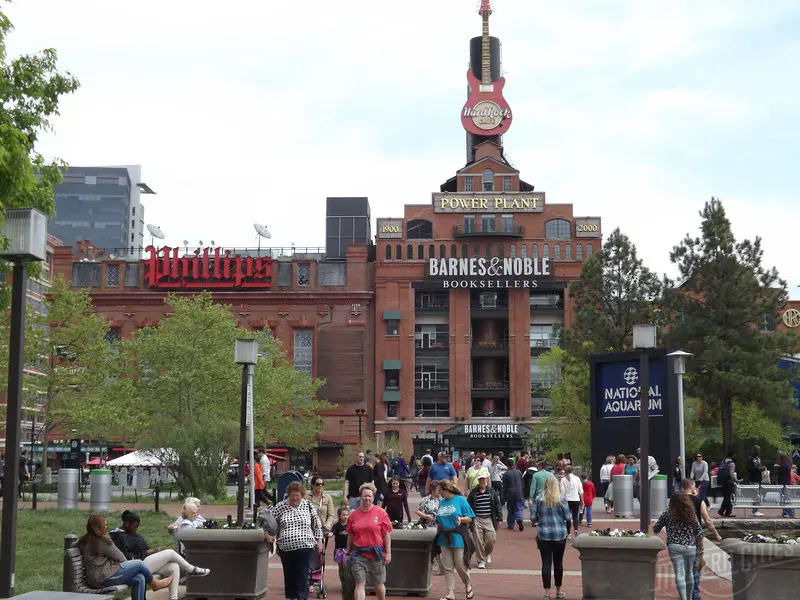
 Baltimore’s Pratt Street Power Plant was built between 1900 and 1909. Operations ceased in 1973. Acquired by the City of Baltimore during the early 1980s, the former industrial facility has been adaptively reused into a variety of uses over the past thirty years. PHOTO: Ennis Davis.
Finding new uses for old buildings significantly reduces the energy consumption associated with demolishing a structure and building a new one to replace it. Mass investment in adaptive reuse introduces the ability for a community to meet the needs of a growing population while conserving land and reducing the expansion of unsustainable urban sprawl and extensive daily commuting patterns.
8. Economic Sustainability
 Originally a part of Barnett National Bank’s corporate headquarters, downtown Jacksonville’s 100 North Laura Street is now an office building with ground floor retail spaces. PHOTO: Ennis Davis.
Potential cost benefits from adaptive reuse include the reduction of the hurdles generally associated with greenfield sites, like legal issues, pressure from anti-development factions, zoning problems, finance, design and construction costs and environmental impacts. These savings can be the difference between an urban project having the feasibility to move forward and a downtown site becoming a surface parking lot for the foreseeable future.
7. The Spaces Can Be Useful for Fledgling Businesses
 Tampa’s Armature Works is a $20 million adaptive reuse project involving the conversion of a long abandoned 119-year-old warehouse into a space featuring two restaurants, event, co-working space and a 22,000-square foot food hall offering several vendor-like stalls leased by local independent chefs and eateries. PHOTO: Ennis Davis.
The adaptive reuse of existing buildings in general can be 16 percent less costly than other forms of construction. Many of these spaces also become ideal settings for start-up businesses because cost efficient shell space can be made available at a lower leasing rate than the market for new construction.
6. Hidden Density
 Atlanta’s Cabbagetown. PHOTO: Ennis Davis.
Areas largely developed before 1950 tend to feature building stock that is designed to be smaller, denser, and mixed-use around narrow streets that accommodate pedestrians over automobiles. This clustering of complementing uses within a compact setting is a key ingredient of vibrancy in cities of all sizes. When razed and replaced with structures designed to accommodate today’s autocentric land use and zoning policies, urban density is typically reduced.
Adaptive reuse is a form of development that gives new life and purpose to old buildings. Many cities have embraced the concept to turn around areas that once suffered from abandonment and general decline. If a city is truly interested in urban revitalization, adaptive reuse is a very important part of achieving that goal. Here are 10 benefits of adaptive reuse that every municipality should consider.
5. Saves time; faster than brand new construction:
 Dating back to 1860, the former Central of Georgia Depot and Trainshed houses the Savannah Visitors Center and the Savannah History Museum. PHOTO: Ennis Davis.
There is an old adage that says time is money. A huge economic advantage for private developers and cities attempting to revitalize their aging urban cores is that a renovated existing building becomes suitable for occupancy sooner rather than later. This allows developers to have cash inflow and for cities to turn around desolate areas in a much shorter time frame.
 Passenger service at Savannah’s Central of Georgia Depot ceased in 1971. In 1990, the Coastal Heritage Society began managing the facility. As opposed to going through the time and expense of constructing a new building, the Savannah History Museum occupies space inside the former depot’s trainshed. PHOTO: Ennis Davis.
4. Cost Savings on Demolition:
 Downtown Orlando’s 1960s-era Orlando Utilities Commission office building was converted into a 118-room Aloft Hotel in 2013. PHOTO: Ennis Davis.
Typically an overlooked expense, demolition costs can run as high as five to ten percent of the total cost of new construction.
3. Preservation Of Local Identity And Sense Of Place:
 A Walmart Neighborhood Market occupies the old San Diego Farmers Market building in the city’s Logan Heights neighborhood. While Walmart is known for “big box” stores, which can generate community opposition, in recent years Neighborhood Markets have mostly opened in vacant commercial spaces, requiring fewer permits, public hearings — and, presumably, having less potential to rile up neighbors. PHOTO: Ennis Davis.
Miami is known for its extensive collection of Art Deco buildings while New Orleans is known for its shotgun architecture. Older buildings not only add and establish the character and scale of our local built environments, they also are a direct physical link to our past, cultural heritage and identity. Cities across the country tend to embrace the concept of adaptive reuse because no matter how one slices it, restoring a historic space goes a long way in preserving local sense of place and authentic experiences that can’t be replicated elsewhere.
2. Takes Advantage Of Urban Revitalization Trends:
 If you ask the city dwellers of Pittsburgh what the definition of “cool” living in the city is, they will all agree on one thing: the Otto Milk Building Condominium is the place to be. Originally built in 1865 for the Phoenix Brewing Company, the Otto Milk Company used this building as a processing and storage factory. Located in the popular Strip District, in recent years, it has been redeveloped into a $14.7 million, 58 unit market-rate condominium complex. PHOTO: Ennis Davis.
Across the country there is great interest in authentic experiences associated with living and working in unique cities with a special sense of place. A magnet for attracting educated young professionals, adaptive reuse of existing buildings is a major characteristic of cities where urban revitalization has been a success.
1. Decreased public and social costs:
 In New Orleans, the Dryades Public Market is a unique solution for a neighborhood that was once a food desert. In 2011, Alembic Community Development acquired the closed Myrtle Banks Elementary School and transformed the space into a building that is now home to a specialty grocery market, arts, nonprofits and other small businesses. PHOTO: Ennis Davis.
In many older cities across the country, the urban core population has declined by more than fifty percent since 1950. Adaptive reuse of vacant structures and landmarks in neighborhoods designed for twice as many people as live there today offers the opportunity to create new affordable housing, start-up businesses and home ownership. In addition, adaptive reuse can serve as a method to reverse the economic decline of inner cities communities while reducing displacement associated with gentrification.
 A look inside Dryades Public Market. PHOTO: Ennis Davis.
(Source: ModernCities.com. No copyright infringement intended)

Leave a Reply